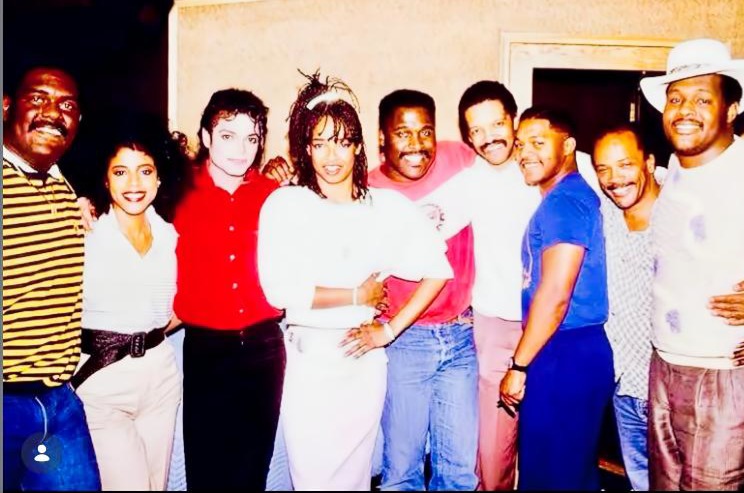
Michael Jackson with members of The Winans, producer Quincy Jones, and songwriter Siedah Garrett. Gospel artists played a significant role in the creation and performance of some of Michael Jackson’s most memorable music.
With the release of the biopic Michael, there is renewed interest in Michael Jackson. The movie is projected to become one of the highest-grossing music biopics ever made. Yet few people realize how deeply gospel music and gospel artists influenced Michael Jackson’s life and some of his biggest songs.
Some of the names connected to Michael may seem like strange pairings at first. But life has a way of bringing very different worlds together. You never know where your purpose will take you or who God may place in your path.
Most people in church circles know about Andraé Crouch and his twin sister, Sandra Crouch. They were gospel pioneers who helped shape contemporary gospel music during the Jesus Movement of the late 1960s and early 1970s. That movement reached many young people who were searching spiritually but did not always connect with traditional church culture. The music reflected the era’s sound and atmosphere while still carrying a gospel message.
Andraé and his group, the Disciples, blended contemporary sounds with traditional gospel roots. They could perform modern music that crossed racial and cultural lines, but Andraé could still “go to church” with the best of the traditional Black gospel singers. Both he and Sandra came out of the Church of God in Christ tradition, where music, rhythm, tambourines, and emotional worship were deeply woven into church life.
What many people do not know is that Sandra Crouch played tambourine on The Jackson 5’s first major hit, “I Want You Back.”
She was brought in as a session musician during the Motown recording sessions in Los Angeles. Sandra had learned her rhythmic tambourine style in church, where that instrument played a major role in worship services. It was through those same church and music circles that she first encountered a young Michael Jackson.
I often wondered how someone from such a strict Pentecostal background ended up playing on secular Motown records. But Andraé and Sandra were always musical innovators. Sometimes they were even criticized within church circles for pushing musical boundaries.
Years later, Michael Jackson became fascinated with the emotional power of gospel music. After watching gospel performances on television, he reached out to Andraé and Sandra and asked to meet with them. Michael admired singers who came out of church traditions because many of them brought deep emotion and spiritual intensity into secular music.
According to Sandra, Michael wanted to understand where that feeling came from.
They met with him at Quincy Jones’ studio and talked about music, spirituality, and life. Sandra and Andraé never publicly shared many details about those conversations, but they reportedly told Michael that the power he was sensing came from the Holy Spirit moving through the music.
That spiritual influence eventually surfaced in one of Michael’s most powerful songs.
While Quincy Jones was producing the Bad album, he brought in the gospel group The Winans to sing background vocals on “Man in the Mirror” along with Andraé Crouch’s choir. At the time, the Winans were among the most influential contemporary gospel groups in America. Like the Crouches, they blended modern sounds with strong traditional gospel roots.
Winans member Carvin Winans later recalled arriving at the studio and meeting Michael and his famous chimpanzee, Bubbles. The group recorded the background vocals with the full gospel energy they were accustomed to bringing in church.
About a week later, Quincy Jones reportedly called them back and asked them to tone the vocals down slightly for Michael’s broader crossover audience. But Michael loved the original emotional intensity.
“Man in the Mirror” went on to become one of the defining songs of Michael Jackson’s career.
When Michael later performed the song at the Grammy Awards, he invited Andraé and Sandra Crouch, along with Andraé’s choir, to join him onstage. He also offered the Winans to appear with him. He even practiced dance moves with the Winans, though they eventually turned down the opportunity. The performance carried the energy of a church service more than a traditional pop performance. Michael became visibly emotional as the choir surrounded him.
I remember people saying afterward that they almost did not know how to process what they had witnessed. Michael was getting close to what church folks call “shouting” when the Spirit moves during worship.
Whatever Andraé and Sandra shared with him privately, there is little doubt that gospel music deeply touched Michael Jackson throughout his life. Behind the sequins, moonwalks, and superstardom was an artist who never lost his fascination with the emotional and spiritual power of gospel music.
There is renewed interest in Michael Jackson, and his music has exploded again. Everywhere, people are talking about Michael Jackson, replaying old songs, revisiting performances, and debating his legacy. I’ve noticed that even many church folks who normally would not discuss pop culture much have gone to see the movie or are talking about it. For many, it brought back memories of the Jackson 5 era, Motown, Thriller, and Michael’s impact on music and culture.
Some of gospel music’s biggest names not only worked with Michael behind the scenes but also counseled him spiritually and helped shape the emotional power behind some of his most memorable songs.
 Konscious_Kansan
Leave a comment